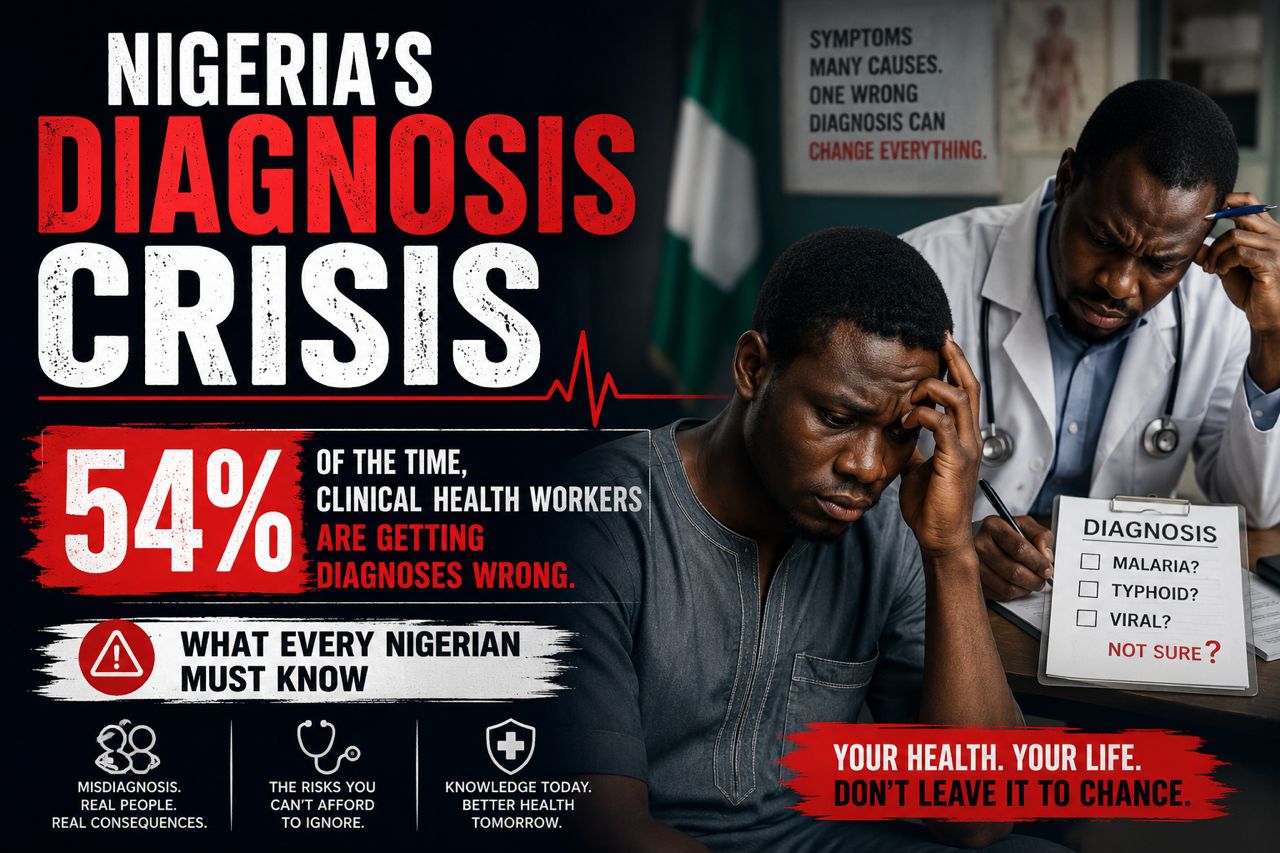
Nigeria’s Diagnosis Crisis: When Doctors Get It Wrong — And What You Can Do About It
Diagnostic accuracy in Nigeria has declined dangerously — and every Nigerian needs to understand what this means for their health in 2026.
A report released in April 2026 by the National Bureau of Statistics has confirmed what many Nigerians have quietly suspected for years. Diagnostic accuracy among clinical health workers in Nigeria’s public health facilities has declined, dropping from 56.2 per cent in 2023 to 46.1 per cent in 2025. The Guardian
Let that sink in.
Less than half of Nigeria’s public health workers are getting diagnoses right. That means if you walk into a public health facility today with symptoms of malaria, pneumonia, or diarrhoea — there is a greater than 50% chance the diagnosis you receive is wrong.
This is not an attack on Nigerian doctors or health workers. Many of them are working in incredibly difficult conditions with limited resources. This is a wake-up call for every Nigerian about the importance of being an active, informed participant in their own healthcare.
What Did the Report Actually Find?
The findings are from the National Health Facility Survey released by the National Bureau of Statistics in Abuja, providing updated data on service quality and healthcare delivery nationwide. The report assessed diagnostic accuracy using vignettes across five priority diseases — diarrhoea, pneumonia, malaria, postpartum haemorrhage and asphyxia — and highlighted persistent gaps in healthcare delivery and clinical decision-making across the country. Punch
The survey visited 3,330 health facilities across all 36 states and the FCT.
Here are the most alarming findings:
Regional breakdown: The North-East recorded the highest diagnostic accuracy at 54.3 per cent, while the South-West had the lowest at 36.7 per cent. TV360 Nigeria
State breakdown: At the state level, Zamfara led with 79.0 per cent, while Osun recorded the lowest performance at just 13.4 per cent. TV360 Nigeria
Primary vs Secondary facilities: Secondary health facilities performed significantly better, recording 68.1 per cent diagnostic accuracy, compared to 44.6 per cent in primary healthcare centres. TV360 Nigeria
Physical examination: Adherence to physical examination guidelines was notably low nationwide at 31.0 per cent. Nannews
Why Is This Happening?
Several factors contribute to this decline:
1. Overcrowded facilities Nigerian public health facilities are severely understaffed and overwhelmed. A doctor seeing 50-100 patients per day cannot give each patient the thorough examination they deserve.
2. Limited diagnostic equipment Availability of basic medical equipment stood at 36.9 per cent nationally, with 34.8 per cent in primary facilities and 76.8 per cent in secondary facilities, highlighting major infrastructure gaps. Peoples Gazette
Without proper equipment — blood pressure monitors, glucometers, stethoscopes, lab testing — accurate diagnosis becomes extremely difficult.
3. Drug shortages On the availability of essential drugs, the report indicated a slight improvement to 37.4 per cent in 2025 from 35.0 per cent in 2023. Nannews
Less than 40% of facilities have essential drugs available. How can you treat a correctly diagnosed condition if the medication isn’t there?
4. Training gaps Clinical decision-making skills require continuous training and updates. Many frontline health workers in Nigeria lack access to regular professional development.
What Does This Mean For You As a Nigerian?
This report does not mean you should stop going to the hospital. It means you need to be a more informed, more proactive patient.
Here is what this data is telling you:
Your symptoms might be misidentified. The five diseases tested — malaria, pneumonia, diarrhoea, postpartum haemorrhage, and asphyxia — are among the most common conditions in Nigeria. If accuracy is this low for these common diseases, imagine the accuracy for rarer or more complex conditions.
Primary healthcare centres carry the highest risk. If you have the option to access a secondary or tertiary facility — use it for serious symptoms. Primary centres recorded significantly lower diagnostic accuracy.
Where you live matters. If you live in the South-West — which recorded the lowest diagnostic accuracy at 36.7 per cent — you face a higher risk of misdiagnosis than someone in the North-East.
How To Protect Yourself
Knowing this information is only useful if you act on it. Here is what every Nigerian can do right now:
1. Understand your own body Learn the basic symptoms of common Nigerian diseases — malaria, typhoid, hypertension, diabetes. When you know what these conditions look like, you can ask better questions and advocate for yourself.
2. Always request a lab test Never accept a diagnosis based on symptoms alone when a lab test is available. Many conditions share similar symptoms. A blood test, urine test, or other diagnostic test gives objective data — not guesswork.
You can read our guide on what your blood test results actually mean to understand your results better.
3. Seek a second opinion If a diagnosis doesn’t feel right — get a second opinion. This is not disrespectful to the doctor. It is your right as a patient.
4. Use higher-level facilities when possible For serious or persistent symptoms — go to a secondary or tertiary facility where diagnostic accuracy is significantly higher.
5. Keep your health records Document your symptoms, your lab results, your medications, and your medical history. This helps every doctor you see give you better care — and helps you spot if something doesn’t add up.
6. Don’t self-medicate Buying drugs based on a wrong self-diagnosis — or a wrong clinical diagnosis — can be dangerous. Ensure every treatment is backed by a proper diagnosis.
The Bigger Picture
This report is a mirror held up to Nigeria’s healthcare system. The reflection is uncomfortable — but it is necessary.
The decline from 56.2% in 2023 to 46.1% in 2025 in just two years is not just a statistic. It represents real people who were sent home with the wrong diagnosis. Real people who took the wrong medication. Real people whose conditions worsened because the right treatment was delayed.
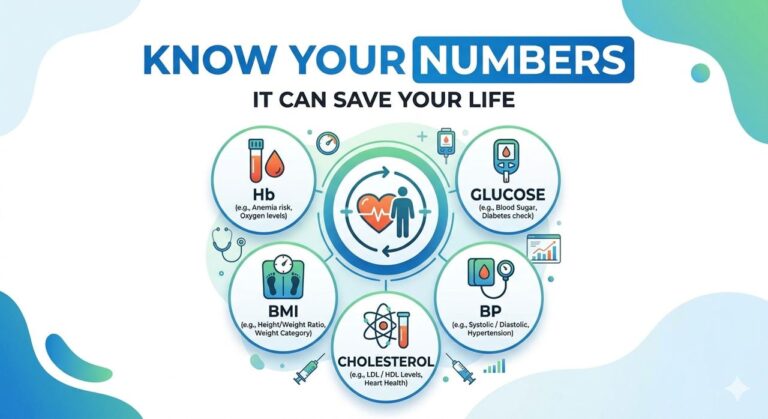
This is exactly why health awareness and education matter so much. When you understand your body, know your numbers, and take an active role in your healthcare — you become harder to dismiss, easier to treat correctly, and less likely to fall through the cracks of an overstretched system.
At RMA by Olushola, this is what we exist for. To give every Nigerian the knowledge they need to navigate the healthcare system with confidence.
Sources:
- National Bureau of Statistics — National Health Facility Survey 2025
- Punch Newspapers — punchng.com
- The Guardian Nigeria — guardian.ng
- TV360 Nigeria — tv360nigeria.com
Disclaimer: This article is for educational and awareness purposes only. Always consult a qualified healthcare provider for medical advice and diagnosis.
Very informative and educational
Very informative