
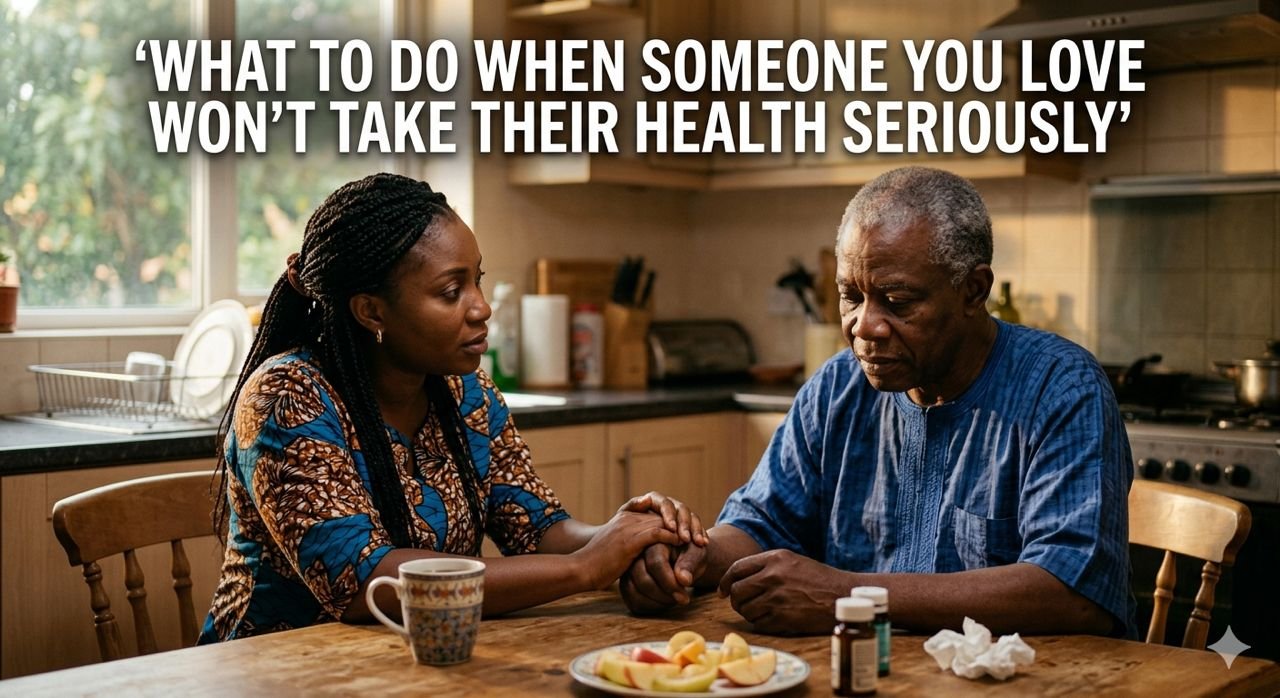
What To Do When Someone You Love Won’t Take Their Health Seriously.
There is a particular kind of helplessness that comes with watching someone you love
ignore their health. You have begged. You have argued. You have sent the voice notes,
forwarded the articles, reminded them for the hundredth time to take their medication.
And still, nothing changes.
If this is you right now, you need to know something first: you are not alone, and you are
not failing them. This is one of the hardest, most quietly exhausting experiences a
Nigerian family can go through, and it deserves more honest conversation than it gets.
The Stubborn Loved One
Maybe it’s your father, diagnosed with hypertension years ago, who still treats his
medication as optional. Maybe it’s your spouse, told repeatedly by their doctor to
manage their blood sugar, who shrugs it off every single time. Maybe it’s a sibling, a
friend, someone whose health you worry about more than they seem to worry about it
themselves.
As a Licensed Medical Laboratory Scientist, I have sat with countless results that tell a
story the person holding them doesn’t want to hear. And I have watched, too many
times, the people who love them try everything to make them listen — only to be met
with silence, deflection, or quiet anger.
What I have come to understand is this: nonchalance about health is almost never about
not caring. It is usually about something underneath — fear, denial, a sense of being
overwhelmed, or simply not truly understanding what is at stake.
Why People Resist, Even When They Know Better
It would be easy to assume that someone who isn’t managing their hypertension or
diabetes simply doesn’t understand the consequences. But in my experience, that is
rarely the full story.
Often, the resistance comes from a place of fear. Taking a diagnosis seriously can feel
like admitting that something is truly wrong — and for many people, especially in a
culture where illness is sometimes treated as weakness, that admission feels heavier
than the disease itself.
Sometimes it is denial. If I don’t think about it, it isn’t really happening. The body feels
fine today, so the threat doesn’t feel real, even when the numbers say otherwise.
And sometimes, honestly, it is simple overwhelm. Chronic conditions ask for a level of
consistency — daily medication, dietary changes, regular monitoring — that can feel
impossible to maintain without support. Without a system, people fall back into old
patterns not because they don’t care, but because remembering everything alone is
exhausting.
Understanding this doesn’t excuse the behavior. But it does change how we, as the
people who love them, can respond
What Doesn’t Work
Before talking about what helps, it’s worth being honest about what doesn’t — because
most of us have tried these approaches out of love, and out of desperation.
Repeated nagging rarely changes behavior. If anything, it builds resistance over time.
The person begins to associate health conversations with criticism, and starts avoiding
the topic altogether, sometimes avoiding you in the process.
Using fear as a tool — describing worst-case outcomes, warning about death, painting
frightening pictures — might create a momentary jolt, but it almost never sustains long-
term change. Fear motivates briefly. It does not build habits.
Making someone feel foolish for not understanding their condition closes the door to
honest conversation. Shame does not invite people to open up about their fears; it
makes them retreat further.
And perhaps the hardest one: giving up on them entirely, even quietly, even just in your
own heart, removes one more person who might have helped them find their way back.
What Actually Helps
The shift that tends to matter most is moving from repeated confrontation to one
honest, calm conversation — not a lecture, not an ultimatum, but a real conversation
rooted in love rather than frustration. Tell them plainly why you’re worried, and let them
hear that it comes from love, not control.
Involving their doctor can also change the dynamic. Sometimes hearing the same
information from a different voice, in a clinical setting, carries a weight that family
conversations simply cannot.
One of the most effective things you can do is stop telling them to track their health, and
instead track it with them. Offer to check their blood pressure together. Sit with them
while they note down their readings. Make consistency something you do as a team, not
something you demand from a distance.
Celebrate small wins rather than focusing only on slip-ups. A week of consistent
medication matters. A blood pressure reading that’s improved, even slightly, matters.
Consistency, not perfection, is the real goal — and it deserves to be acknowledged.
What You Can and Cannot Control
You cannot force someone to take their health seriously. No amount of love, pressure, or
evidence can make that decision for them. This is a hard truth, but an important one to
sit with, because so much of the exhaustion in these situations comes from trying to
control an outcome that ultimately belongs to someone else.
What you can do is make it easier for them to say yes. Structure removes the burden of
remembering. A system — even a simple one — makes consistency more achievable
than willpower alone ever could. And knowing that someone is paying attention, that
someone is in it with them, often makes people try harder than they would on their own.
This is exactly the gap that led to building the RMA Health Journal. Not as a replacement
for the conversations you’re having, but as a tool that makes those conversations easier
to act on. A structured place for daily readings, medication tracking, symptoms, and
appointments — something that turns “I should track this” into something genuinely
doable, for both the person managing their health and the people supporting them.
If You Love Someone Who Is Struggling
If this describes your situation right now, here is what matters most.
Don’t just pray for them, though prayer matters. Don’t just worry about them, though
worry comes from love. Build a system with them. Show up with them. Make it as
difficult as possible for them to feel like they are doing this alone.
Sometimes the most powerful medicine isn’t a prescription at all. Sometimes it’s simply
knowing that someone cares enough to stay — through the resistance, through the
frustration, through the moments when nothing seems to be changing.
That presence, more often than not, is what eventually makes the difference.
Promoting Health. Empowering Accountability.
RMA by Olushola | rmabyolushola.com | @rmabyolushola