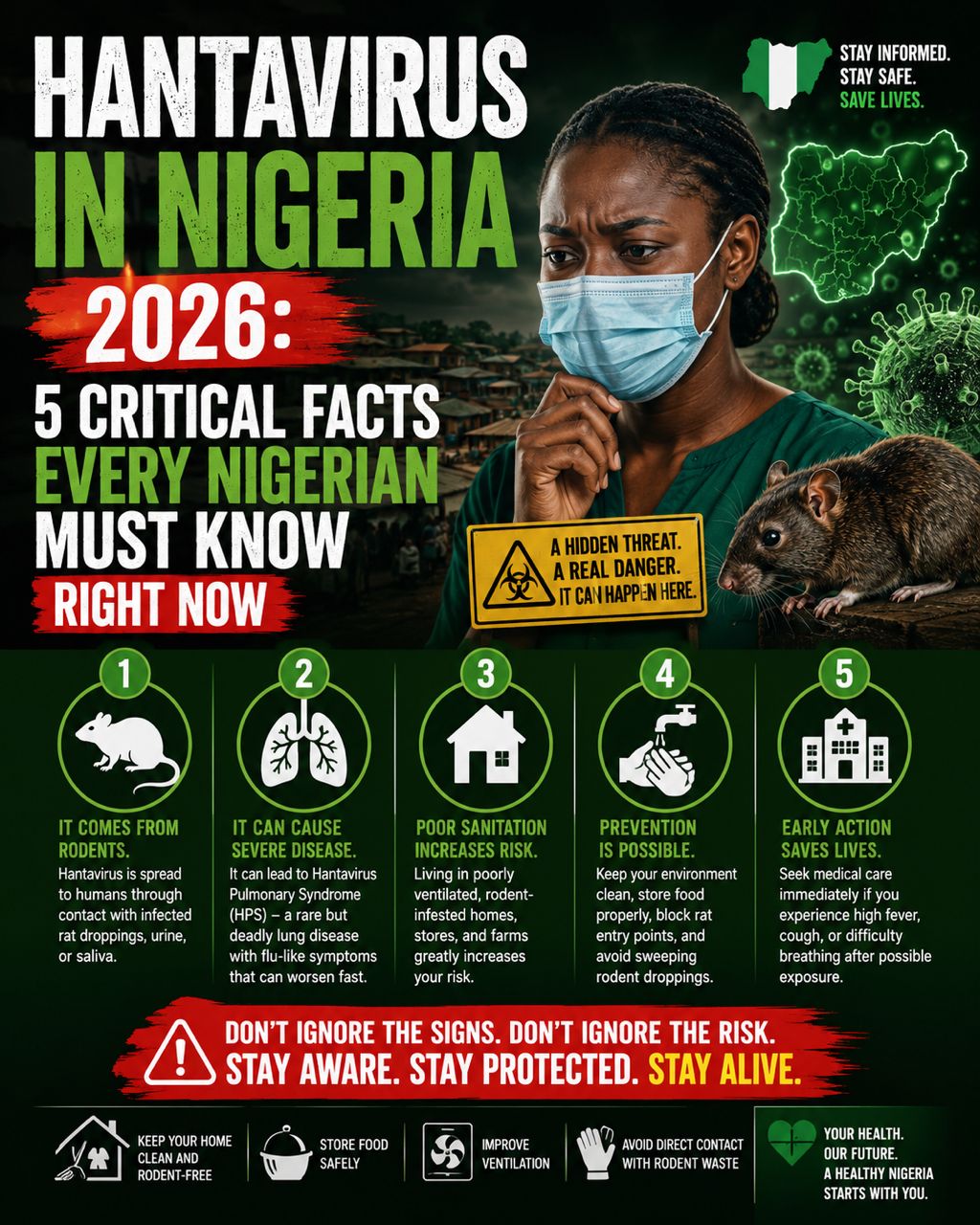
Hantavirus in Nigeria 2026: 5 Critical Facts Every Nigerian Must Know Right Now
By now, you have probably seen Hantavirus trending on Twitter, Instagram, and in WhatsApp groups. And with trending health topics in Nigeria, two things always happen: the real information gets buried, and the fear spreads faster than the disease itself.
So before you forward that next voice note, before you panic, and before you assume the worst — let me give you what you actually need. The facts. Clearly. From a licensed Medical Laboratory Scientist who understands both the science and the Nigerian context you live in.
What Is Hantavirus — And Why Is Everyone Talking About It?
Hantavirus is not a new virus. It has existed for decades. Scientists have known about it since the 1950s when it caused a disease outbreak among United Nations soldiers during the Korean War.
What makes it news right now is a specific outbreak on a cruise ship called the MV Hondius. In April 2026, this ship departed Argentina for a voyage through the Canary Islands. Within weeks, passengers began falling seriously ill. Three people died. Ten cases have been confirmed or are probable. Patients are now receiving treatment in six countries — South Africa, the Netherlands, Germany, Spain, Switzerland, and France.
The World Health Organisation (WHO) officially declared the outbreak on May 6, 2026. The specific strain involved is called the Andes virus — and it is the reason this outbreak is being watched closely around the world.
| 3 DEATHS CONFIRMED | 10 CONFIRMED & PROBABLE CASES | 6 COUNTRIES WITH PATIENTS |
How Does Hantavirus Spread? The Part Most People Get Wrong
This is where a lot of the misinformation starts. People hear “virus” and they assume it spreads like the flu — through a cough, a sneeze, casual contact. That is not how most Hantavirus strains work.
There are over 50 known types of Hantavirus in the world. Almost all of them only spread through contact with infected rodents — specifically through their urine, droppings, saliva, and nesting materials. When a person comes into contact with these, especially by inhaling dust contaminated with rodent droppings, they can become infected.
So ordinarily, you cannot catch Hantavirus from another person. You can only get it from a rat or mouse.
“The Andes virus is the only known Hantavirus strain that can spread from person to person — and it is precisely the strain involved in the current outbreak.”
— WHO Disease Outbreak News, May 2026
That single fact is what makes this particular outbreak unusual and why global health authorities are taking it seriously. On that cruise ship, in close quarters, in enclosed spaces — the Andes virus spread between people directly. That is rare. That is why the world is watching.
How Does Person-to-Person Spread Happen with the Andes Virus?
The Andes strain spreads through very close, prolonged contact with an infected person — through respiratory droplets or bodily fluids. It does not spread through casual contact or brief interactions. This is not an airborne virus that floats across a room. It requires sustained proximity to someone who is already symptomatic.
In the context of the cruise ship, researchers believe the combination of close living quarters, shared spaces, and extended time together created the conditions for spread. Under normal daily circumstances in Nigeria, your risk from this specific strain is extremely low — especially since no cases exist in the country.
What Are the Symptoms of Hantavirus?
Hantavirus typically progresses in two stages. The early stage looks almost identical to malaria or typhoid — which is exactly why awareness matters for Nigerians. Here is the full breakdown:
| Stage | Timeframe | Symptoms |
| Early Stage | Days 1–5 | Fever, severe headache, muscle aches (thighs, hips, back), chills, nausea, vomiting, diarrhea, abdominal pain |
| Late Stage (HPS) | Days 4–10 | Shortness of breath, lungs fill with fluid, rapid deterioration, respiratory failure, low blood pressure, shock |
The incubation period — the time between exposure and first symptoms — can range from 4 to 42 days. This wide range is part of what makes detection challenging.
CRITICAL WARNING
According to the CDC, 38% of people who develop Hantavirus Pulmonary Syndrome — the advanced breathing stage — may die from the disease. There is currently NO specific antiviral treatment for Hantavirus. Medical management is supportive only. This makes prevention the most powerful tool available.
Why Does This Matter for Nigerians Even Without Any Cases?
I want to be honest with you here, because I think Nigerians deserve honest health conversations.
Right now, in the immediate term, Hantavirus is not your biggest health threat as a Nigerian. Malaria, typhoid, hypertension, diabetes, Lassa fever — these are the conditions taking Nigerian lives every single day.
1. We Live in a Connected World
The three Hantavirus deaths so far involved people who traveled from a ship to South Africa, then to Europe. A passenger who felt fine when they disembarked could have carried the virus into any airport in the world. COVID already demonstrated this reality to us in vivid detail.
The NCDC has not activated surveillance because Hantavirus is in Nigeria. They activated it because the global situation warrants monitoring. That is responsible governance. And we as citizens should match that with responsible awareness.
2. Nigeria Is Not Rodent-Free
The standard Hantavirus strains spread from rodents. Nigeria has a significant rodent challenge in both urban and rural environments. Markets, homes, drainage systems, and food storage areas are common rodent habitats. Lassa fever, which is also rodent-borne and actively killing Nigerians right now in 18 states, is proof of that. The hygiene practices that protect you from Lassa fever are the same ones that protect you from Hantavirus.
How to Protect Yourself and Your Family
The good news about Hantavirus is that prevention is straightforward. It does not require expensive medications or special equipment. It requires consistent, simple hygiene practices.
Frequently Asked Questions About Hantavirus in Nigeria
Q: Can I catch Hantavirus in Nigeria right now?
A: Based on current confirmed information, the answer is no. The NCDC has confirmed zero cases in Nigeria as of May 2026. The Hantavirus strains present in other parts of the world have not been identified in Nigerian rodent populations. Continue following normal hygiene practices and monitor official NCDC updates.
Q: Should I avoid travelling because of Hantavirus?
A: The WHO has not issued any travel restrictions related to Hantavirus as of May 2026. The global risk level is described as LOW. If you are travelling to Argentina, Patagonia, or Southern Cone regions of South America — known Andes virus areas — take standard rodent-avoidance precautions particularly in rural settings.
Q: Is Hantavirus the same as Lassa fever?
A: No. They are completely different viruses. However, both spread from rodents. Lassa fever is caused by the Lassa virus, spread from the Mastomys rat, and is a real, active threat in Nigeria right now with 160 deaths recorded in the first quarter of 2026 alone. The prevention strategies overlap significantly: rodent control, proper food storage, and hygiene.
Q: What should I do if I think I have Hantavirus symptoms?
A: If you have recently returned from international travel — particularly from South America or countries with confirmed cases — and you develop fever, severe muscle aches, fatigue, or breathing difficulty, please seek immediate medical attention. Tell your doctor about your travel history. Do not attempt to self-diagnose or self-medicate.
Q: Is there a vaccine or treatment for Hantavirus?
A: Currently, there is no approved vaccine for Hantavirus available to the general public globally. There is also no specific antiviral drug that targets Hantavirus. Treatment is supportive — doctors manage your symptoms and support your breathing while your immune system fights the virus. This is why prevention is everything with this disease.
The Bigger Lesson: Why Health Awareness Is Your Best Protection
Every time a new disease makes international news — COVID, Monkeypox, now Hantavirus — we see the same pattern in Nigeria. The people who panic the most are the people who knew the least. The people who remained calm and protected were the ones who understood what the disease was, how it spread, and what to do.
Knowledge is not just power. In health, knowledge is protection.
“The diseases that kill the most Nigerians are not the ones making
international headlines. They are the ones we have normalised, dismissed, and stopped being alarmed by.”
RMA by Olushola
Hantavirus is not in Nigeria today. But Lassa fever is. Malaria claimed 978,000 cases in Lagos alone last year. Diabetes is killing 40,000 Nigerians annually. High blood pressure affects 4 in every 10 Nigerian adults. These are the battles happening right now, on Nigerian soil, in Nigerian bodies.
Stay informed on all of them. That is why this platform exists.
SOURCES & REFERENCES
↗ WHO Disease Outbreak News — MV Hondius Hantavirus (May 2026) · who.int/emergencies/disease-outbreaknews/item/2026-DON599
↗ CDC — Hantavirus Situation Summary (May 2026) · cdc.gov/hantavirus/situation-summary/index.html
↗ NCDC — Hantavirus Advisory Nigeria (May 9, 2026) · bellanaija.com/2026/05/ncdc-hantavirus-advisory-nigeria-may-2026/
↗ Wikipedia — MV Hondius Hantavirus Outbreak · en.wikipedia.org/wiki/MV_Hondius_hantavirus_outbreak
↗ ABC News Live Updates — Hantavirus (May 2026) · abcnews.com
↗ NETEC — Lassa Fever Nigeria 2026 Update · netec.org
↗ Daily Post Nigeria — Lagos 978,000 Malaria Cases (2026) · dailypost.ng